Who Is Liable for a Truck Underride Crash in Columbus, Ohio?
By John K. Rinehardt, Board Certified Civil Trial Attorney (NBTA)
10-18-26
When a Car Slides Under a Truck: Understanding Your Rights in Columbus
Key Takeaways: Liability for a truck underride crash in Columbus, Ohio may fall on the truck driver, the trucking company, the trailer or guard manufacturer, a maintenance shop, or a loading company, depending on why the guard failed or was missing. Federal standards FMVSS 223 and 224 set strength and installation requirements for rear guards, and FMCSA rules require carriers to inspect and maintain them. No federal law requires side underride guards, but claims may still be possible under negligence or product liability theories. In Ohio, violating a federal safety regulation is often treated as evidence of negligence rather than negligence per se, though the answer can depend on the specific rule. Compensation may be reduced or barred under the state’s modified comparative fault rule. Key evidence, such as the trailer, the guard, and electronic data, can disappear quickly, so early preservation is critical. Most personal injury and wrongful death claims must be filed within two years under Ohio law, but exceptions and other deadlines may apply.
After a truck underride guard accident, liability can fall on several parties, including the trucking company, the driver, the trailer manufacturer, the guard manufacturer, or a maintenance contractor. Which one is responsible generally depends on why the crash happened and whether the guard was missing, damaged, poorly designed, or too weak to stop the car. An underride crash happens when a passenger vehicle slides beneath the back or side of a tractor-trailer, often striking the car at windshield level and causing catastrophic or fatal injuries. In Columbus, heavy truck traffic on I-70, I-71, and I-270 puts local drivers at real risk. If you or a loved one were hurt, it helps to understand how responsibility is determined before you talk to an insurance company.
If a trucking company’s insurer is already calling you, you don’t have to deal with them alone. Rinehardt Injury Attorneys helps injured Ohioans and grieving families look into underride crashes and pursue accountability. Call 419-529-2020 or contact us now to talk about your situation.
Why Underride Crashes Are So Dangerous
Underride crashes are especially deadly because they bypass the safety systems built into passenger cars. Crumple zones, airbags, and seatbelts work when the front of the car absorbs impact. When a car goes under a trailer, the trailer bed can strike the windshield and its occupants directly. A rear underride guard, the steel bar hanging from the back of a trailer, is meant to stop a car before this happens.
Federal safety investigators have long pointed to weak underride protection as a factor in severe injuries. The National Transportation Safety Board issued a safety recommendation on underride guards, known as H-13-014, urging NHTSA to strengthen underride standards, focusing partly on single-unit trucks, which historically lacked the same rear guard requirements as trailers. Findings like these may help show the industry knew about the dangers of inadequate guards.
Federal Standards That Shape Truck Underride Crash Liability
Federal rules set the baseline for how underride guards must be built and maintained, and are often central to proving a party fell short of its legal duties.
Manufacturing and Performance Standards
Federal Motor Vehicle Safety Standards (FMVSS) 223 and 224 govern rear underride guards on most trailers and semitrailers. FMVSS 223, at 49 C.F.R. § 571.223, sets strength and energy absorption requirements. FMVSS 224, at 49 C.F.R. § 571.224, requires many trailers to have guards meeting those requirements, though some special-purpose trailers and single-unit trucks are excluded. These standards grew from NHTSA’s vehicle crashworthiness research, which studies how vehicle structures hold up in underride and override crashes. NHTSA amended these standards over time, including a 2022 rule effective for trailers made on or after July 15, 2024. Whether a guard complied is generally judged by the version in effect when the trailer was manufactured.
Maintenance and Inspection Rules
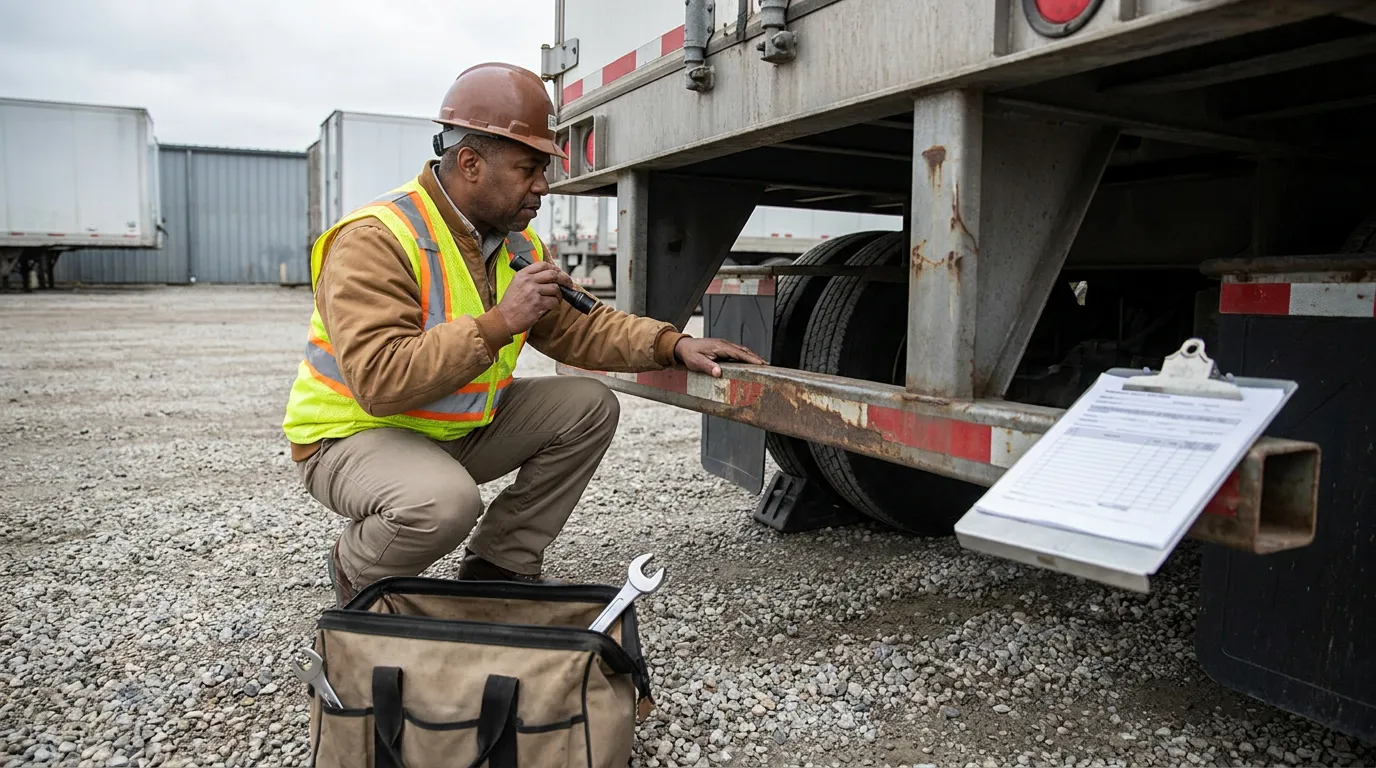
Motor carriers have separate duties to keep guards in working condition. Federal Motor Carrier Safety Regulations at 49 C.F.R. § 393.86 cover rear impact guards on commercial vehicles in operation, and 49 C.F.R. Part 396 requires carriers to inspect, repair, and maintain equipment. A guard that was rusted, bent, cracked, or removed may point to a maintenance failure even if it met federal standards when built.
The Side Underride Gap
No federal law currently requires side underride guards on tractor-trailers. Safety advocates such as the Truck Safety Coalition call this gap a preventable cause of deaths. The lack of a mandate can make side underride claims harder to bring, though it doesn’t rule them out. In Ohio design defect cases, courts may consider whether a feasible, safer alternative design was available, even without a federal requirement.
Who May Be Responsible in a Truck Underride Guard Accident
Most underride cases involve more than one potentially liable party, and each party’s role generally determines its possible share of responsibility.
| Potential Defendant | Common Basis for Liability |
|---|---|
| Truck driver | Sudden braking, stopping illegally, poor lighting, fatigue |
| Trucking company | Negligent maintenance, failed inspections, vicarious liability for the driver |
| Trailer manufacturer | Defective design or manufacture, failure to meet FMVSS 223/224 |
| Guard manufacturer | Weak welds, poor materials, inadequate testing |
| Maintenance or repair shop | Improper repairs or failure to replace damaged guards |
| Loading company | Improper loading that affected trailer height or stability |
Crashes involving several vehicles can make fault even harder to sort out. Our overview of who can be held liable in multi-vehicle truck crashes explains how responsibility may be divided when more than two vehicles are involved.
How Ohio Law Applies to Underride Claims
Ohio law generally decides how fault is divided and what compensation may be available. Federal standards define what a responsible party should have done, while state law generally controls the claim itself.
Negligence and Regulatory Violations
In Ohio, breaking a federal safety regulation does not necessarily prove negligence on its own. The Supreme Court of Ohio has held that violating an administrative rule is generally evidence of negligence, not negligence per se (Chambers v. St. Mary’s School, 82 Ohio St.3d 563 (1998)). Some Ohio courts treat certain federal motor carrier safety regulations adopted into Ohio law differently, so the effect of a violation can depend on the rule involved. Either way, a guard that failed FMVSS or FMCSA requirements may still be strong evidence, but the injured person generally must still show the violation caused the injuries.
Product Liability Claims
Claims against manufacturers generally fall under the Ohio Product Liability Act, R.C. 2307.71 through 2307.80. A guard may be defective in manufacture (R.C. 2307.74), design (R.C. 2307.75), warnings (R.C. 2307.76), or nonconformance with the manufacturer’s representations (R.C. 2307.77). Under R.C. 2307.75, a design isn’t defective unless a practical, feasible alternative existed that would have prevented the harm without substantially impairing usefulness. Proof of FMVSS compliance may be considered, but it doesn’t automatically defeat a design defect claim.
Comparative Fault
Under Ohio’s modified comparative negligence rule, R.C. 2315.33, your compensation may be reduced by your share of fault, and barred entirely if your fault exceeds the combined fault of all parties from whom you seek recovery. Trucking insurers often argue the car driver was following too closely; clear evidence about the guard’s condition can help push back. Under R.C. 2307.22, a defendant found more than 50% at fault may be jointly and severally liable for economic damages. Defendants 50% or less at fault are generally liable only for their proportional share, and non-economic damages are generally apportioned by fault.
💡 Pro Tip: Ask a trusted family member to photograph the truck’s rear guard, if safe to do so. Guards are sometimes repaired or replaced soon after a crash.
Evidence That Can Make or Break Your Case
Underride claims often depend on physical evidence that can disappear quickly, as trucking companies may repair trailers and data recorders can be overwritten. Important evidence may include:
- The trailer and underride guard itself, preserved for engineering inspection
- Electronic control module and dashcam data from the truck
- Maintenance, inspection, and repair records for the trailer
- Manufacturer testing and certification documents for the guard
- Police crash reports and scene photographs
- Driver logs and hours-of-service records
A formal preservation letter sent early can help stop evidence from being destroyed; if that’s not enough, a court order may be needed. Accident reconstructionists and engineers are often needed to explain how the guard failed and whether a compliant guard would have prevented or reduced the injuries.
Deadlines for Underride Guard Accident Ohio Claims
Ohio generally allows two years from the date of injury to file a personal injury lawsuit under R.C. 2305.10, and wrongful death claims generally must be filed within two years of death under R.C. 2125.02. Product liability claims are also generally subject to a 10-year statute of repose under R.C. 2305.10(C), measured from delivery to the first purchaser, with limited exceptions. Certain tolling rules, such as those for minors, may apply in limited circumstances, but courts interpret these narrowly, so tolling should never be assumed. Claims against government entities, such as those involving road design, may involve immunity defenses and separate procedural requirements.
Frequently Asked Questions
1. Can I sue if the truck had an underride guard but it failed?
Possibly. A guard that failed may point to a design defect, a manufacturing defect, or poor maintenance. An engineering analysis is usually needed to determine which applies.
2. What if the crash was a side underride?
Because there is no federal side guard mandate, these claims usually focus on driver negligence, trailer visibility and lighting (including federal reflective tape and lighting rules), or product liability theories involving safer alternative designs. Whether a claim is viable depends heavily on the facts.
3. Does a federal regulation violation guarantee I win?
No. In Ohio, a violation of an administrative regulation is generally treated as evidence of negligence, and your own comparative fault can still reduce or bar recovery. You would still need to prove causation and damages.
4. What damages may be available?
Depending on the facts, compensation may include medical expenses, long-term care, lost wages, lost earning capacity, pain and suffering, and wrongful death damages. Under R.C. 2315.18, Ohio caps non-economic damages in most personal injury cases. The caps don’t apply to certain catastrophic injuries, such as permanent loss of a limb or bodily function, and generally don’t apply to wrongful death damages. Punitive damages are limited separately under R.C. 2315.21.
5. How soon should I speak with a lawyer?
As soon as you reasonably can. Early action can help preserve the trailer and electronic data before they are lost.
Holding the Right Parties Accountable
Finding out who may be liable for a truck underride guard accident often means looking at the driver, the carrier, the manufacturers, and the repair shops. Federal standards like FMVSS 223 and 224 set the benchmark, while Ohio negligence and product liability law generally determine how that benchmark may turn into compensation. Every case depends on its own facts, and evidence can disappear quickly. Working with a Columbus truck accident lawyer can help you understand your options.
You deserve answers about what happened and who should be held responsible. Rinehardt Injury Attorneys is ready to review your underride crash and help protect your family’s future. Call 419-529-2020 or schedule your consultation today.
Disclaimer: This content is for informational purposes only and is not legal advice. Every case is unique, and results may vary. Consult an attorney about your specific circumstances.