Who Can Be Held Liable for a Nursing Home Fall in Mansfield, Ohio?
By John K. Rinehardt, Board Certified Civil Trial Attorney (NBTA)
08-08-26
Understanding Fault When a Loved One Falls in a Care Facility
Key Takeaways: When a loved one falls in a Mansfield care facility, liability can extend to multiple parties: the nursing home operator, individual caregivers, contracted service providers, and third parties whose negligence created a hazard. Ohio negligence law requires proving who owed a duty of care, who breached it, and whose breach caused the harm. Identifying the correct defendant and the facility’s licensing classification is critical. Understaffing frequently drives these cases. Ohio’s modified comparative negligence rule can reduce or bar recovery if the resident shares fault beyond 50 percent, and short filing deadlines, including a possible one-year medical claim period, make prompt action essential. Preserving evidence such as care plans, incident reports, and staffing logs strengthens your case, and experienced counsel can identify every responsible party and protect your procedural rights.
When an aging parent or spouse suffers a serious fall inside a Mansfield care facility, more than one party may be legally responsible. Liability can extend to the nursing home operator, individual staff members, a contracted therapy provider, or a third party whose conduct contributed to the hazard. Ohio negligence law focuses on who owed a duty, who breached it, and whose breach caused the harm, making defendant identification one of the most important early steps.
Falls rarely have a single cause. Multiple parties may share fault to varying degrees, which shapes how families should think about accountability. Pinpointing every responsible party can affect the outcome of a claim.
If your family is facing the aftermath of a fall, the team at Rinehardt Injury Attorneys is ready to help. Call us at 419-529-2020 or reach out through our contact page to discuss your options.
How Ohio Law Defines the Facilities That May Be Liable
Understanding how Ohio law classifies the facility is the starting point for any liability question. Different licensing categories carry different duties and influence which regulations and standards apply. Under Ohio law, a "nursing home" means a home used for the reception and care of individuals who require skilled nursing care due to illness or physical or mental impairment, and those who require personal care services but not skilled nursing care.
Ohio’s statutory scheme is broad. The term "home" includes any institution, residence, or facility providing accommodations for more than twenty-four hours to three or more unrelated individuals dependent upon others’ services. This captures nursing homes, residential care facilities, homes for the aging, and similar long-term care providers that owe safety duties to residents.
Classification matters practically. A residential care facility provides accommodations and personal care services for individuals dependent on others due to age or impairment, and may provide limited skilled nursing care under section 3721.011 of the Revised Code. Review Ohio’s statutory definitions of care homes to understand which regulations apply and identify the correct operator.
Why Licensing Status Can Point to the Responsible Operator
Identifying the licensed operator reveals the party with primary legal duty to a resident. The part or unit providing skilled nursing care beyond section 3721.011 authorization is licensed as a nursing home. When a corporate parent, management company, and local facility are involved, this distinction helps determine which entity was responsible for staffing, supervision, and safety protocols at the time of the fall.
Parties Who May Share Responsibility for a Fall
More than one defendant can often be pursued in a Mansfield nursing home injury case. Multiple parties may share fault depending on the circumstances.
Common potential defendants include:
- The facility operator or ownership entity, responsible for adequate staffing, fall-risk assessments, and safe premises.
- Individual caregivers or nurses whose actions or inaction contributed to the fall.
- Contracted service providers, such as therapy companies, transport services, or maintenance vendors.
- Third parties whose negligence created or ignored a hazard.
Understaffing frequently sits at the center of these cases, because stretched teams may miss warning signs or fail to respond promptly. Our discussion of chronic understaffing in nursing homes explains how these conditions lead to nursing home neglect in Mansfield Ohio.
💡 Pro Tip: Request a copy of the resident’s care plan and fall-risk assessment early. These records often show whether the facility identified a fall risk and whether staff followed documented precautions.
Proving Negligence in an Ohio Nursing Home Fall Claim
Most nursing home fall cases rest on a negligence theory requiring proof of specific elements. A plaintiff must prove the defendant failed to use the appropriate level of care and that this failure caused the injuries. A claimant must establish duty, breach, causation, and damages.
Duty and breach turn on the standard of care a facility owed the resident. A residential care setting and skilled nursing setting may be held to different expectations, which is why licensing analysis carries real weight. Causation asks whether the facility’s conduct led to the fall, and damages cover quantifiable harms, including medical expenses, additional care costs, and pain and suffering.
Family members may also have their own claims in certain situations. Derivative claims include those of a parent, guardian, custodian, or spouse arising from an individual’s medical diagnosis, care, or treatment when relatives are directly affected by the harm, subject to the facts and applicable deadlines.
Preserving Evidence That Supports Your Claim
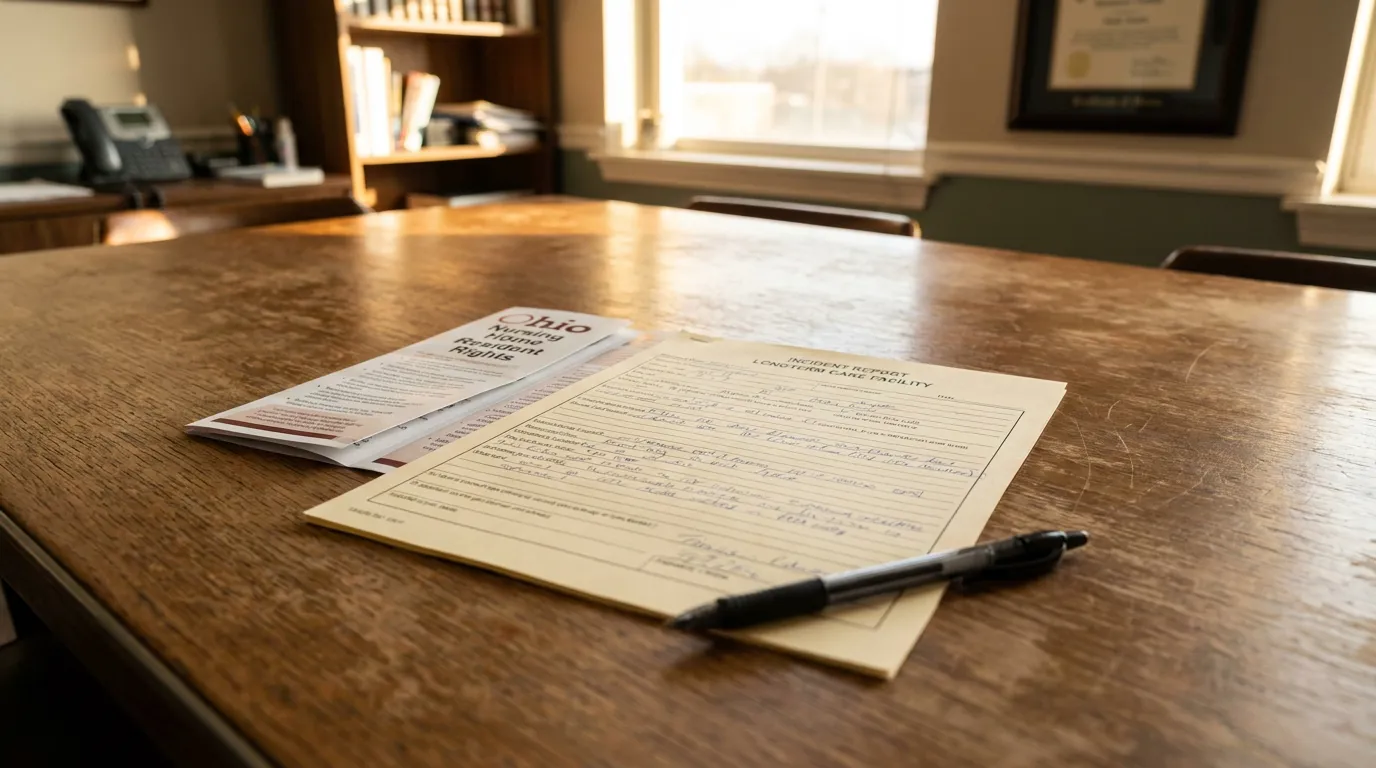
Evidence tends to disappear quickly after a fall, so early preservation is critical. Photographs of the scene, incident reports, staffing logs, and witness statements can all demonstrate what happened and why. Gathering documentation promptly gives your case the strongest foundation and helps counsel evaluate whether the fall reflects nursing home negligence in Ohio.
How Comparative Fault and Deadlines Shape Your Case
Ohio’s comparative negligence rule and filing deadlines can significantly affect recovery. Ohio follows modified comparative negligence, where a resident’s recovery is reduced by their share of fault and barred entirely if that share exceeds the combined fault of all defendants, generally, more than 50 percent. Under this rule, a plaintiff can recover damages reduced by their percentage of fault as long as their fault doesn’t reach the bar threshold of 50 or 51 percent, depending on the state. Over 30 states use some form of modified comparative negligence.
Deadlines deserve careful attention. When a fall involves medical care or treatment, a shorter clock may apply. Ohio law provides that an action upon a medical, dental, optometric, or chiropractic claim shall be commenced within one year after the cause of action accrued. Whether a nursing home fall qualifies as a "medical claim" or ordinary negligence is fact-dependent.
There is a limited extension option. Written notice that the claimant is considering bringing an action allows the action to be commenced within 180 days after notice is given. This tolling opportunity requires strict compliance. Review Ohio’s medical claim limitations statute to see how these timing rules are structured.
| Issue | General Ohio Framework |
|---|---|
| Fault allocation | Modified comparative negligence, recovery barred when the resident’s fault exceeds 50 percent |
| Medical claim deadline | One year after the cause of action accrues |
| Possible extension | Up to 180 days with proper written notice, applied narrowly |
💡 Pro Tip: Do not assume you have years to act. If any part of the fall involves medical care, the shorter one-year period may control, so seek guidance quickly.
Why Families Rely on Experienced Ohio Personal Injury Lawyers
Sorting out liability, licensing categories, and deadlines is difficult during a stressful time, which is why many families work with seasoned counsel. The team of ohio personal injury lawyers at our firm focuses on establishing fault and documenting damages while protecting your procedural rights. A knowledgeable Mansfield Ohio injury attorney can identify every responsible party, evaluate whether the claim sounds in medical malpractice or general negligence, and preserve needed evidence.
Public legal forums are not a substitute for tailored advice. Experienced ohio personal injury lawyers apply the law to your specific facts rather than general scenarios.
Frequently Asked Questions
1. Can the nursing home and an individual employee both be sued for the same fall?
Yes, multiple parties may be named in many cases. Ohio negligence principles allow a plaintiff to pursue multiple defendants when the facts support it, including both a facility and individuals whose conduct contributed to the injury.
2. How long do I have to file a nursing home fall claim in Ohio?
It depends on how the claim is characterized. If the fall involves medical care or treatment, a one-year medical claim deadline may apply, while other negligence claims may follow different timelines. Prompt legal review is important.
3. Will my loved one’s own actions reduce the recovery?
Possibly, under Ohio’s modified comparative negligence rule. Damages may be reduced by the resident’s percentage of fault, and recovery may be barred entirely if that share exceeds the combined fault of all defendants, generally, more than 50 percent.
4. What if understaffing contributed to the fall?
Inadequate staffing can be strong evidence of a breach of duty. When a facility fails to provide enough trained personnel to supervise at-risk residents, that shortfall may support a claim, though the outcome turns on the particular facts.
Protecting Your Family’s Rights After a Fall
A nursing home fall in Mansfield can involve several potentially responsible parties, a fact-specific negligence analysis, and short filing deadlines that make early action valuable. From identifying the licensed operator to weighing comparative fault and preserving key records, each step influences whether a family can hold the right party accountable.
If your loved one suffered a fall and you are unsure who may be liable, the compassionate team at Rinehardt Injury Attorneys is here to listen and explain your options. Call us today at 419-529-2020 or request your consultation online so we can help you take the next step toward protecting your family.